Quite a few years ago, my teacher, Greg, wrote to me: “Even a happy person is not free.”
This sentence has resonated a long time, echoing in the background of my thoughts. Even a happy person is not free.
We were talking about awareness and consciousness and being a person. I finally realized that Greg was talking about not being a person. He was telling me that there is more than being a person. Or, in other words, there is less.
To be free, truly free, is to let go of the person. To see myself in an entirely different way. That is, to see myself as awareness. This is why Greg called his book, Standing As Awareness.
There are glimpses of this non-person experience throughout Buddhist literature, including Tilopa’s Song. This nondual experience is so compelling, so shocking, and yet, so ordinary, that writers have attempted to capture it in writing for centuries.
The completely open nature of all dimesions and events is a rainbow always occurring yet never grasped.
Greg was pointing out to me that the person and the concerns of the person are simply arisings to awareness. But the person is not free. It is only in standing as awareness itself that freedom exists.
I tend to mix and match languages. I know that Greg would not approve. He is a purist, and would like to allow each tradition to stand on it’s own, without reference to other languages or metaphors. Or perhaps it’s more that he is so respectful of each tradition that he would not want to step on any toes by unskillfully appropriating language, for example, as he once mentioned in a story to illustrate this point, renaming an experience of the Holy Ghost. “What this actually was, was a kundalini awakening.” I’m sure he is correct to honor each tradition. Of course, this makes sense. But at the same time, words are only words. There is freedom here, too.
As space is always freshly appearing and never filled, so the mind is without limits and ever aware. Gazing with sheer awareness into sheer awareness, habitual, abstract structures melt into the fruitful springtime of Buddhahood.
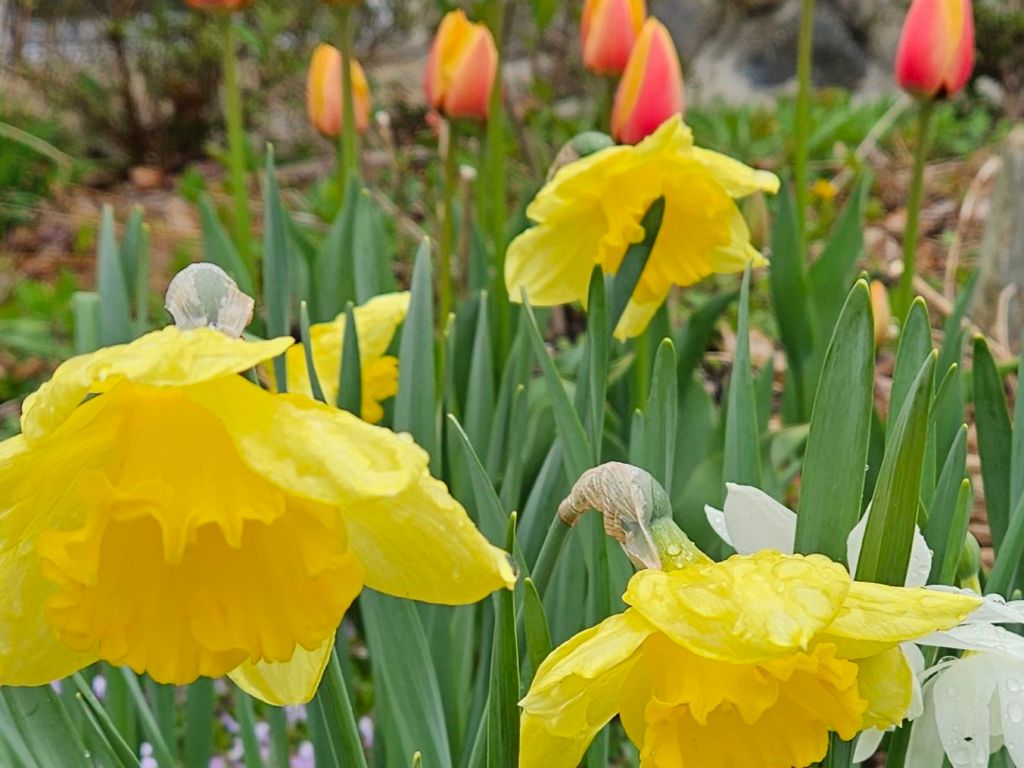
I wonder where Tilopa was when he wrote these words. Or perhpas he did not write them at all, but sang them spontaneously to Naropa. Where were they? What color was the sky? What flowers were blooming that springtime so many years ago? Here and now, daffodils and forsythia blossom bright yellow and the Buddha mind floats between green grass and rain.
White clouds that drift through blue sky, changing shape constantly, have no root, no foundation, no dwelling: nor do changing patterns of thought that float through the sky of mind.
Rain today. Life is a miracle. The heart is constantly opening. Namo Guru.
 Ed Gabrielsen
Leave a comment