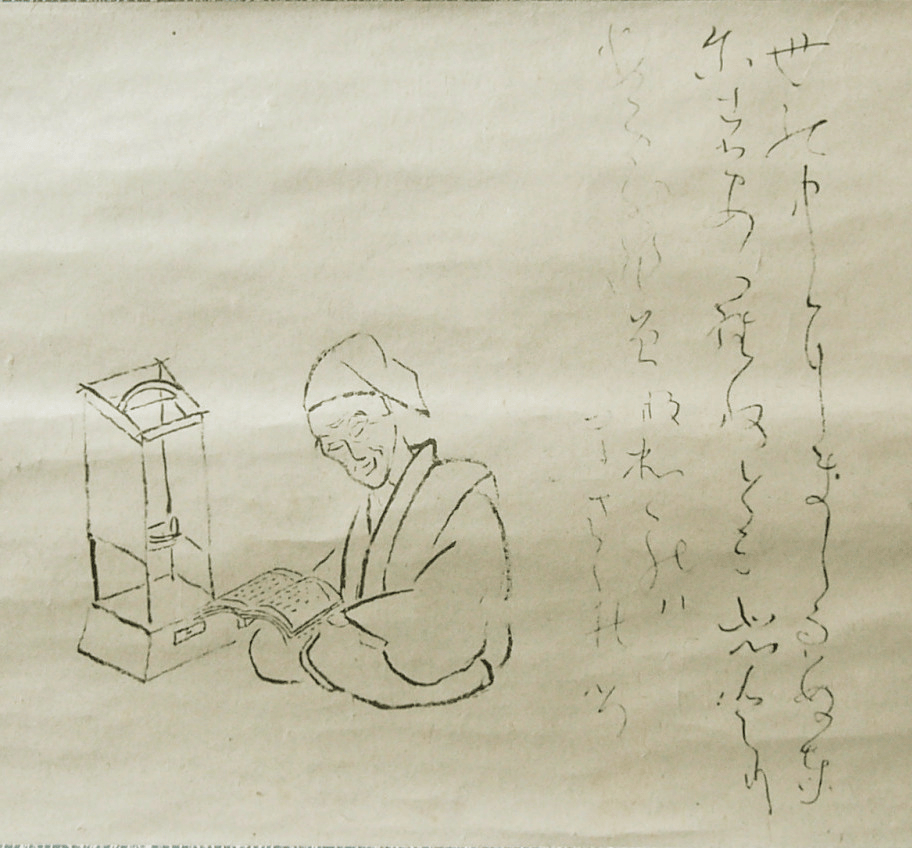
The poet, Ryokan, (1758-1831) was a Japanese Zen Buddhist monk who lived most of his life as a hermit. In simple, hand written calligraphy, he produced many poems, among them, the following:
I watch people in the world
Throw away their lives lusting after things
Never able to satisfy their desires,
Falling into deeper despair
And torturing themselves.
Even if they get what they want,
How long will they be able to enjoy it?
For one heavenly pleasure
They suffer ten torments of hell
Binding themselves more firmly to the grindstone.
Such people are like monkeys
Frantically grasping for the moon in water
And then falling into a whirlpool.
How endlessly those caught up in the floating world suffer,
Despite myself, I fret over them all night,
And cannot staunch my flow of tears.
So many people are unhappy. They are unhappy because they do not see things the way they are. Buddha taught that this is the basic suffering of human beings. It is the suffering of ignorance.
Ignorance here does not mean lacking intelligence. It means to ignore, that is, to not see clearly. Ignorance is the basic delusion, the basic misunderstanding. All other forms of suffering stem from this basic ignorance.
The beloved Theravadin teacher, Ajahn Chah, used to say, “You can’t make a chicken a duck. A chicken will never be a duck.” What did he mean by this?
When we want life to be other than it is, we suffer. We have some idea about the way life is supposed to be, or the way we want it to be. But that is not the way things are. So, we are trying to make a chicken a duck. We are trying to make life something that it is not. This is one form of suffering.
But deeper than this, is the suffering caused by misidentification. At a most fundamental level, we do not know who we are. We do not identify ourselves correctly. We think we are something we are not. And we have no idea who or what we are. This the fundamental suffering, the most basic suffering.
The only way to really be free from suffering is to practice the Dharma. Or, if you prefer a more generalized version of this statement, we could say that the only way to really be free from suffering is to realize the truth about life and about our identity. Suffering is what drives people into the spiritual search. In other words, suffering drives people into a search for answers, for some way to find relief from pain and confusion. Suffering makes us want to find what matters.
A good place to begin is to notice directly, to observe directly, that nothing stays the same. Everything changes. There is nothing to hang onto. This is the law of impermanence.
From moment to moment, nothing stays the same. And yet, we try to make things stay the same. The world is fleeting. Experience is fleeting. This body is fleeting. Relationships are fleeting. Even so, we grasp and cling, and work so hard to gain something: a trip, a delicious meal, a new computer, a new pair of shoes. Perhaps we save enough money to buy a beautiful house. But even so, even if we could have 10 billion dollars in the bank, two Mazeratis, and a summer home in Switzerland, how long could we keep these things? This is what Ryokan is saying. Even the most heavenly pleasures do not last.
Meanwhile, while some people hoard money in their greed, fight wars because of greed, dominate others because of a lust for power, none of these things will last. There is actually enough food for everyone. But because of war, hoarding, greed, and lust for power, there are people who are starving. It is a travesty. Grasping for the moon in water, we fall into the whirlpool. And Ryokan’s tears are not yet staunched.
So, what do we do?
See through the illusion by contemplating impermanence. It is uncomfortable to do so, because it goes against our every inclination. But this is the way to freedom, to be free from suffering. The contemplations on impermanence offer a way into the Dharma; a way into the experience of no-self, into the suchness of this. Just this. And it is the unchanging truth.
As the Buddha taught in the Diamond Sutra:
“So I say to you—This is how to contemplate our conditioned existence in this
fleeting world:
Like a tiny drop of dew, or a bubble floating in a stream;
Like a flash of lightning in a summer cloud,
Or a flickering lamp, an illusion, a phantom, or a dream:
So is all conditioned existence to be seen.”
 Ed Gabrielsen
Leave a comment