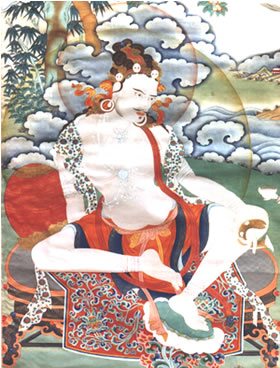
This is part 1 in a series of commentaries I am writing on the text, “Tilopa’s Song to Naropa,” or, as it is sometimes called, “Tilopa’s Song of the Mahamudra.”
1. “Mahamudra, the royal way, is free
from every word and sacred symbol.“
The word, “mahamudra:”
The word “mahamudra” is a Sanskrit term. It combines two words: maha meaning “great,” and mudra meaning “symbol,” “gesture,” or “seal.” The term is usually translated as “great seal” or “great symbol.”
Great Seal
The reference to seal suggests sealing a letter, for example, with sealing wax. In sealing a letter, you put a stamp on it with a sign or symbol and you seal it closed. The letter is finished. It is final. There is nothing further to write. It is perfect and complete.
Great Symbol.
The reference to symbol suggests that once emptiness is seen, once the truth of emptiness is experienced as a living reality, then everything and every moment is the display of emptiness. Everything, every phenomenon that arises is, itself, emptiness. It is a symbol of itself. It is an expression and a manifestation of emptiness. It is emptiness itself, through and through. Once this is seen and experienced, it is unmistakeable and enduring. The symbol continues to reaffirm the truth. Hence, “great symbol.”
(I should probably add that the word “enduring” is not generally speaking a concept or theme found in the emptiness teachings. “Enduring” is not an emptiness term. Probably something like “reliable” or “verifiable” would be more fitting. But here is the problem with words. So, there is something fitting about using “enduring” to talk about this stuff. And perhaps, a reminder to keep a sense of humor about the whole thing, seeing the futility of the attempt, while at the same time, making it anyway! There is joy here, a quiet joy. Joyful irony, indeed!
Completion of the path, and the path itself.
So in this way, Mahamudra is the completion of the path. The experience of mahamudra is the experience of emptiness. This is the goal of everything the Buddha taught: the end of suffering. Mahamudra is the realization of nirvana within samsara, or, in other words, the realization that samsara is nirvana. They are two sides of the same coin. For the practitioner who arrives at this realization, the letter is sealed. The path is complete. This is Buddhahood.
Mahamudra is an important practice in Tibetan Buddhism and is especially associated with the Kagyu lineage.
In this sense, Mahamudra is the goal of the entire Buddhist path. It is a goal. And it is also the path itself. As Chogyam Trunpa wrote, “the path is the goal.” Mahamudra is the realization of mind, that is, the realization of non-separation. It is the experience that nirvana and samsara are the same, right here and now. So Mahamudra is a meditation path, and it is also the culmination of the path. Ultimately, Mahamudra is the experience of the timeless present. This is the end of suffering. It is what the Buddha taught.
Mahamudra is a “royal way.” When we think of royalty, we think of a king or queen sitting on the throne. They have a certain bearing or poise, a way of being which is “regal.” A king or queen is completely present and sane. There is a commanding presence which is not affected but completely natural. It is a royal presence. These are people who, without trying, walk into a room and immediately gain attention. There is something about them that is different. They are confident in themselves and in their being human. Even if they need to blow their nose or sneeze, there is no self consciousness. They are not in a hurry, but are exactly and precisely in the moment, attuned to the situation and what is going on.
This presence is the natural result of what the Buddha described as the quality of mindfulness, the devolpment of which he taught in a structured program outlined in the Satipatthana Sutta.
And this royalty also implies a way of behaving, that is, an ethics. Royalty does not run stop signs or cause harm to others. So the royal way is a kind of narrowing of options. It’s not a free-for-all. There are constraints. But these constraints are arrived at through wisdom. Royalty knows the laws of consequence, and these laws are embedded. The royal way is one with the laws of karma, and so the choices simply operate on their own. There is a natural flow of right action.
Mahamudra is “free from every word and sacred symbol.” In other words, it is non-conceptual and non-sectarian. Mahamudra cannot be owned by any particular group, nor can it be described in words. Even though mahamudra becomes a central focus in the Kagyu tradition, Tilopa presents it as a universal experience, more than merely belonging to Buddhism. Moreover, there is no adequate symbol for mahamudra. It is beyond words and symbols because it is experience itself, awareness itself, prior to the arising of words or symbols.
As Pei Hsiu wrote in his preface to Huang Po:
“Mind is like the sun journeying through
the sky and emitting glorious light uncontaminated by the
finest particle of dust. To those who have realized the nature
of Reality, there is nothing old or new, and conceptions of
shallowness and depth are meaningless. Those who speak
of it do not attempt to explain it, establish no sects and
open no doors or windows. That which is before you is it.”
(John Blofeld, trans., The Zen Teachings of Huang Po, On the Transmission of Mind, Grove Press, New York, 1958, p. 27)
(more later)
 Ed Gabrielsen
Leave a comment